
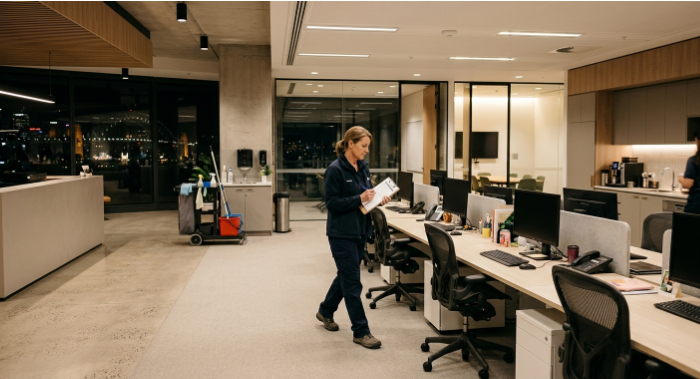
Start commercial deep cleaning with urgent hygiene or safety needs, then assess bathrooms, shared kitchens, entrances and heavily used floors. Once essential work is addressed, prioritise remaining spaces according to their condition, usage, safe access and available budget.
Trying to deep clean every corner of your workplace at once can drain the budget and interrupt business without fixing the most pressing problems. Yet focusing only on what looks dirty may leave more important cleaning needs unresolved. Effective commercial deep cleaning begins with deciding what requires attention now and what can be scheduled later. This guide sets out seven practical checks, a priority matrix and a phased plan to help Sydney businesses make that decision with confidence.
What Is Commercial Deep Cleaning, and Why Prioritise It?
Routine commercial cleaning keeps agreed spaces maintained: regular floor care, waste removal, amenities and frequently touched surfaces. A deep clean goes further into build-up, difficult-to-reach but accessible details and treatments that are not always part of the everyday schedule. So, the exact tasks should be written into the scope rather than assumed from the service name.
Prioritisation matters because a reception carpet, shared bathroom and seldom-used store room are unlikely to need the same intervention at the same time. A sensible plan first deals with non-deferrable risks and facility-specific requirements, then allocates remaining time and budget where detailed cleaning will make the most useful difference.
For a broader view of ongoing maintenance, you may see commercial cleaning services in Sydney.
Which Areas Should Be Deep Cleaned First?
There is no universal room-by-room order for every workplace. Start with an inspection, because a lightly used area containing a spill or contamination issue may need urgent action before a busy but otherwise well-maintained foyer.
Where no urgent concern takes precedence, high-use bathrooms, shared kitchens, building entrances and busy circulation areas are sensible places to assess first. Carpets, detailed edges and lower-use rooms can then be scheduled according to their actual condition, surface requirements and available access.
7 Checks to Prioritise Commercial Deep Cleaning
1. Identify urgent hygiene and safety concerns
First address cleaning-related hazards and mandatory hygiene requirements before discretionary deep-cleaning work. Walk through the premises and identify spills, contaminated surfaces, slippery floors, overflowing waste and other conditions needing immediate action.
A treatment room subject to a facility cleaning procedure cannot simply be deferred to fit the weekend budget. Similarly, suspected hazardous materials or significant mould may require specialist assessment rather than standard cleaning.
If the check fails: Control access where necessary, notify the responsible manager and arrange the appropriate response. Keep urgent work separate from optional detailed cleaning in the scope.
2. Inspect bathrooms, shared kitchens and touchpoints
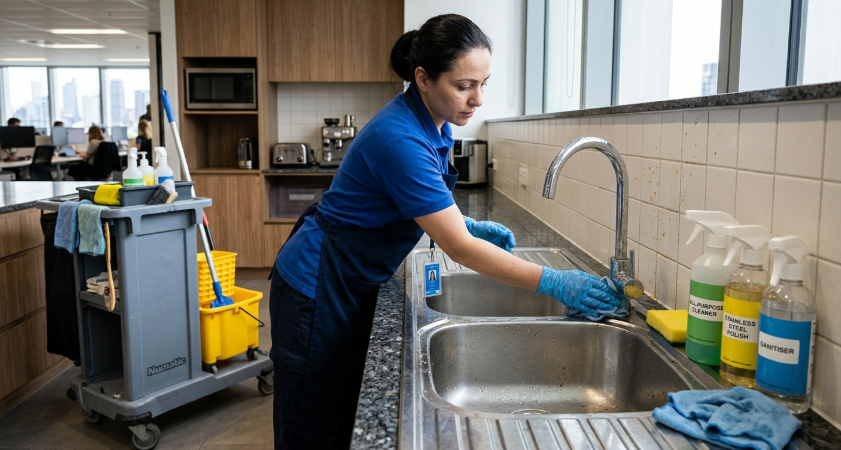
High-use amenities often deserve an early detailed assessment because routine cleaning may not reach accumulated residue around fixtures, grout lines, splashbacks or other agreed areas. Check both the visible condition and the history of complaints; a persistent smell should be investigated rather than repeatedly masked.
Deep cleaning and disinfection are not interchangeable. Routine cleaning removes dirt and residues, while disinfection is used where justified by the site’s risk and procedures.
If the check fails: Specify the exact neglected tasks, confirm product and surface suitability, and review whether the regular cleaning schedule needs adjustment.
3. Review foot traffic and the condition of floors and carpets
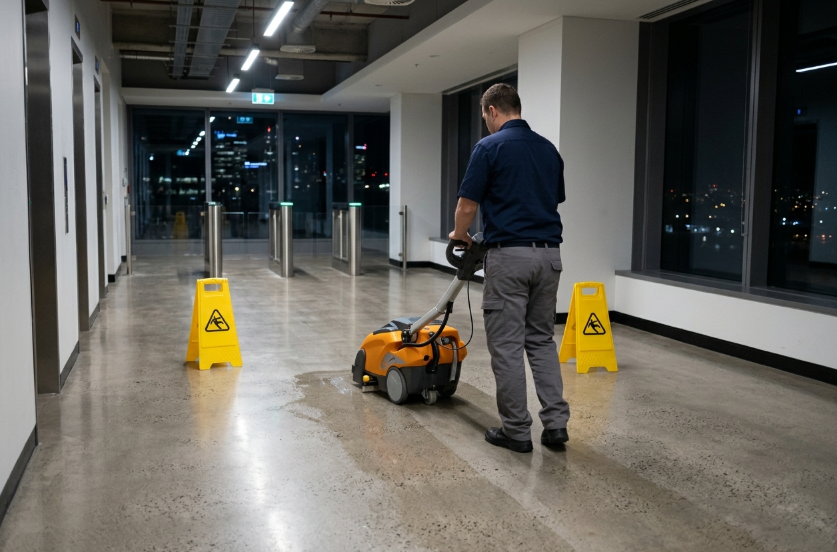
Assess entrances, main walkways, shared meeting spaces and reception areas for embedded dirt, staining, residue or wear. A floor that looks dull may need an appropriate cleaning treatment, but damage or deterioration can instead call for maintenance or repair.
Carpet extraction, machine scrubbing and specialist surface treatment require suitable methods and sometimes restricted access or drying time. The right treatment depends on the floor material, manufacturer guidance and site condition, not merely how many people walk across it.
If the check fails: Ask for a surface-specific recommendation and clarify whether the proposed method is included in the quote. Keep repairs separate from cleaning tasks.
4. Find the details excluded from regular cleaning
Inspect skirting boards, partition tops, door frames, accessible vents, furniture edges and spaces behind movable items. These are common candidates for periodic work because daily and weekly contracts often concentrate on more frequently used surfaces.
However, not every overlooked area should be cleaned immediately. Assess the condition and whether moving furniture, working at height or using specialised equipment introduces additional risks or costs.
If the check fails: List the areas explicitly in the deep-cleaning scope, confirm safe access and equipment, then schedule lower-urgency details in an appropriate phase.
5. Match cleaning priorities to the type of facility
An office, medical centre and childcare centre cleaning in Sydney should not be treated as interchangeable sites. Offices may emphasise shared amenities and workspaces, while medical settings must follow their own infection-prevention arrangements and childcare centres must consider children, products and reopening requirements.
For specialised premises, the responsible manager should confirm cleaning procedures, approved materials, records and access conditions before any general deep-cleaning checklist is applied.
If the check fails: Have the facility’s responsible person review and approve the scope, and use suitably experienced professionals for specialist requirements.
6. Plan safe access, timing and business disruption
Map each task to a realistic access window. Busy kitchens, shared corridors and customer-facing entrances may be easier to treat after hours, while floor work can require time for drying and safe reopening.
A phased programme can allow one section to remain operational while another is cleaned, provided equipment, chemical handling and access restrictions are properly managed. Agree on keys, alarms, furniture movement, signage and the handover process before work begins.
If the check fails: Change the timing or split discretionary work into smaller stages. Never shorten a necessary safety or drying period simply to meet a reopening target.
7. Match the budget to a documented scope and completion check
A useful quote identifies the rooms and surfaces, individual tasks, method or equipment where relevant, access conditions, exclusions and any additional charges. It also explains how the completed work will be checked against the agreed scope.
When a full deep clean cannot be funded immediately, essential work should be dealt with first and lower-priority tasks scheduled in stages. This is better than asking several providers to quote a vague “full clean” with different assumptions.
If the check fails: Request an itemised revision, agree on what belongs in each phase and record who will inspect the work after completion.
For general NSW workplace considerations, make sure you review SafeWork NSW guidance on maintaining a safe working environment, including spill management, safe access and hazardous substances.
Build a Commercial Deep Cleaning Priority Matrix
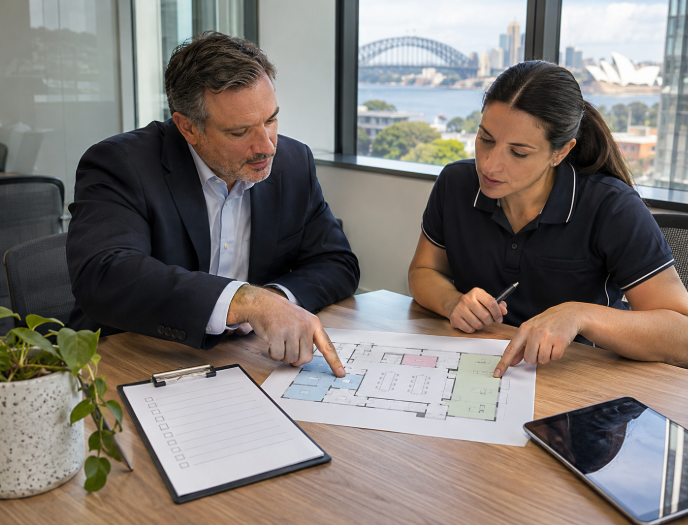
A priority matrix gives a manager a consistent way to decide what comes first, instead of relying on appearance or the loudest complaint. First, identify anything requiring immediate or mandatory action. Only then should discretionary tasks be compared on soiling, usage, operational impact and safe access.
| Area/example | What to assess | Suggested decision |
| Shared bathrooms | Residue, odour, hygiene concerns and existing schedule | Urgent matters first; otherwise early detailed assessment |
| Staff kitchen | Food residue, grease and appliance edges | High-use priority if condition warrants it |
| Entrance and reception | Heavy traffic, marks and floor condition | Assess cleaning needs and surface treatment |
| Meeting rooms | Frequency of use and built-up dust | Planned phase if no urgent issue |
| High accessible surfaces | Accumulated dust, safe access and equipment | Scheduled detailed cleaning |
| Treatment rooms | Facility-specific procedures and infection-prevention requirements | Follow required cleaning procedures; do not defer essential work |
| Childcare play areas | Centre procedures, occupancy and reopening | Schedule to the centre’s requirements |
Use three practical categories: (1) urgent or required work, (2) high-use or heavily soiled areas needing early attention, and (3) lower-priority detailed work that can be scheduled.
Note: These are planning categories, not formal NSW risk ratings. A specific site assessment can change the order.
How Priorities Change Between Sydney Properties
Offices and shared workplaces
In a typical office, examine bathrooms, staff kitchens, entrances and high-traffic floors before moving to partitions, meeting rooms and less-used storage. The cleaning scope should separate routine maintenance from periodic carpet treatment or detailed work so tasks are neither missed nor charged twice.
A tailored plan for office cleaning in Sydney can help keep ongoing tasks aligned with the periodic deep-cleaning programme.
Medical centres and allied health premises
Medical facilities need cleaning based on their clinical activities, infection-prevention procedures and surface requirements. A generic office deep-cleaning checklist must not replace the facility’s approved procedures or any additional infection-control requirements.
If you want to learn more about medical centre cleaning in Sydney, feel free to check out the guide. The NSW Clinical Excellence Commission also provides environmental-cleaning guidance for healthcare.
Childcare centres and education facilities
Play areas, amenities and shared equipment need cleaning arrangements appropriate to the centre’s activities, ages of children and documented requirements. Plan additional treatment outside occupied periods where necessary and confirm that products and surfaces are suitable before reopening.
Review the site’s operating needs alongside school and childcare cleaning options.
Strata and shared commercial areas
For a shared building, lifts, lobbies, corridors and bin rooms may be managed under a separate cleaning arrangement from individual tenants’ offices. Confirm who authorises and pays for any additional deep clean, and make sure the scope does not duplicate existing contractual work.
In NSW, this is generally discussed as strata cleaning; the phrase “body corporate cleaning Sydney” may appear in searches, but responsibility depends on the property and its agreements.
Worked Example: A Phased Deep Clean for a Sydney Office
Consider a hypothetical 300 m² Sydney office containing workstations, meeting rooms, a shared kitchen, bathrooms and a reception area. The manager can provide access over three separate evenings but cannot close the entire workplace. These dimensions and phases are illustrative, not a SweepShine project or a cost estimate.
| Stage | Focus | Why this order may work |
| Initial inspection | Identify urgent hygiene, safety and access needs | Required work is prioritised before optional tasks |
| Evening 1 | Bathrooms and shared kitchen | Treat identified build-up in busy amenities |
| Evening 2 | Reception and appropriate floor or carpet work | Allow specialist treatment and safe drying time |
| Evening 3 | Meeting rooms, skirting and neglected details | Complete lower-priority detailed tasks |
| Handover | Check each task against the written scope | Record completion and any follow-up |
The actual order may differ. If an urgent issue is identified during inspection, it should be addressed under the relevant procedure rather than waiting for the scheduled phase. Cleaning times and costs should come from the provider’s site assessment, not assumptions based only on floor area.
How Can Commercial Cleaners Work Around Business Hours?
Start by dividing the premises into practical zones and identifying which tasks need restricted access. Then agree on any security procedures, equipment movement, warnings, drying time and safe handover conditions before scheduling the work.
A phased arrangement may suit a Sydney office, retail premises, or managed building with narrow after-hours windows. However, healthcare and childcare settings may have additional restrictions that take priority over convenience.
What Should a Commercial Deep Cleaning Quote Include?
A useful commercial deep-cleaning quote should let you compare equivalent work, not just headline prices. Ask for a written schedule that records the areas, tasks and the results the provider will check at completion.
- Exact rooms, surfaces and agreed cleaning tasks.
- Any specialist floor, carpet, appliance or other treatments.
- Equipment, products, staff access and after-hours arrangements.
- Areas requiring isolation, drying or a separate specialist assessment.
- Exclusions, additional charges, GST and variation approvals.
- Completion checklist, inspection contact and follow-up procedure.
For more complex facilities, you may request a site walkthrough before accepting a quote. A detailed scope also helps determine when periodic work should become part of ongoing commercial cleaning services instead of being arranged only after complaints arise.
When Should Deep Cleaning Become Part of Regular Maintenance?
A recurring deep-cleaning schedule makes sense when the same detailed tasks repeatedly fall outside routine maintenance or when the condition of particular areas shows a predictable pattern. The appropriate interval depends on usage, material, access, cleaning standards and any specific facility requirements.
Instead of assuming all offices require quarterly or six-monthly deep cleaning, review actual inspection findings and service records and adjust the plan when occupancy, activities or the premises change.
Frequently Asked Questions
Start with urgent hygiene or safety concerns, then assess busy bathrooms, shared kitchens, entrances and heavily used floors. Other areas can be scheduled according to their condition, traffic and the available cleaning budget.
Routine commercial cleaning maintains agreed areas on a regular schedule, while deep cleaning addresses more detailed or infrequent tasks. The exact difference depends on the contract and the property’s needs.
There is no universal interval for every Sydney office. The right frequency depends on occupancy, surface condition, daily cleaning standards and any facility-specific requirements.
Yes, many commercial deep-cleaning tasks can be scheduled outside normal operating hours. The provider must still confirm access, equipment requirements, drying times and when areas can safely reopen.
No. Deep cleaning targets accumulated dirt and residue, while disinfection uses a suitable product and procedure to address microorganisms on surfaces. Disinfection should be based on actual risks and facility requirements.
Costs depend on floor area, condition, the agreed scope, equipment, access and timing. Request an itemised quote because a standard recurring-cleaning rate may not cover specialist deep-cleaning work.
Yes. Medical premises need cleaning arrangements suited to clinical activities, infection-prevention procedures and the risks of individual areas. A general office checklist is not a substitute for those requirements.
Some areas may remain operational while others are cleaned, depending on the work and its risks. Tasks requiring restricted access, chemical controls, or drying time should be isolated until they can safely reopen.
The best starting point is not to clean every room in the same order. Instead, identify essential needs, assess high-use spaces, plan other detailed work around access and budget, and agree on what successful completion looks like.
If you are unsure which parts of your premises need attention first, explore a reliable commercial cleaning service in Sydney or request a tailored cleaning assessment to discuss a suitable scope for your workplace.