

A Sydney office cleaning company should be measured against agreed results, not simply the number of hours a cleaner spends on site. For facilities managers, business managers and school administrators, an office cleaning quality inspection scorecard provides a consistent way to assess cleaning standards, record defects and check whether corrective actions are completed.
So the right approach for a Sydney office combines a written cleaning scope of work, measurable key performance indicators (KPIs), regular inspections and documented follow-up. Educational facilities may also require additional site-access, safeguarding and contractor-screening controls.
For businesses comparing office cleaning Sydney service providers, a consistent inspection process offers a practical way to assess whether the agreed cleaning standards are being met. This guide explains which cleaning KPIs to measure when comparing Sydney office cleaning companies, how to calculate an inspection score, and how to use a practical scorecard when reviewing a cleaning contractor or preparing for a contract renewal.
What Is an Office Cleaning Quality Inspection Scorecard?
An office cleaning quality inspection scorecard is a structured assessment tool that compares the condition of a workplace against its agreed cleaning requirements. It records inspection results, identifies deficiencies, and tracks corrective actions over time.
A cleaning checklist identifies the tasks that must be completed. A quality inspection scorecard checks whether the required outcome was achieved. For example, a cleaner may record that a washroom was cleaned, but an inspection should also establish whether the basin, toilet, floor, and high-touch surfaces meet the agreed standard.
A useful scorecard records the inspection date, area assessed, result, supporting evidence, defect severity, corrective-action owner, and closure status. It should reflect the property’s actual cleaning scope rather than applying identical expectations to every workplace.
Which Cleaning KPIs Should a Contract Measure?
Commercial cleaning quality control works best when the contract measures a small set of meaningful indicators. The following are suggested starting points; agree the targets, reporting frequency, and calculation rules with the provider.
| KPI | What it measures | Example calculation |
| Inspection pass rate | Proportion of inspected items meeting the agreed standard | Passed items ÷ applicable items × 100 |
| Task completion rate | Proportion of scheduled tasks recorded as completed | Completed tasks ÷ scheduled tasks × 100 |
| Repeat-defect rate | Whether previously identified problems recur | Repeated defects ÷ total recorded defects × 100 |
| Corrective-action closure | Whether defects are resolved by the agreed deadline | Actions closed on time ÷ actions due × 100 |
| Complaint rate | Frequency of substantiated cleaning complaints | Substantiated complaints per reporting period |
| Consumable availability | Whether required soap, paper, and other supplies are available | Compliant checks ÷ checks performed × 100 |
Task completion and inspection pass rate
Task completion is a useful operational measure, but it is not proof of quality. A completed-task record should be supported by inspections that test whether the agreed result was achieved.
For example, vacuuming may be marked complete while visible debris remains around workstation edges. The task completion rate may be high, but the inspection result should identify the deficiency.
Repeat defects and corrective-action closure
A recurring problem may indicate an unclear scope, insufficient time, inadequate training, equipment issues, or ineffective supervision. Record the defect, investigate its cause, and assign a corrective action.
Measure whether actions are completed by the agreed deadline and whether the next inspection confirms that the problem has been resolved. Do not treat a closed action as successful until the required outcome has been verified.
Complaints, attendance and hygiene supplies
Track substantiated complaints alongside inspection results. Complaint volume alone is not a reliable measure of quality because reporting practices and occupancy levels vary.
Attendance and service continuity can also be monitored against contractual requirements. Record missed visits, late arrivals, or replacement arrangements where these affect service delivery.
For washrooms and kitchens, include checks for required consumables and observable cleaning outcomes. Visual inspection is useful for assessing visible cleanliness, but it does not independently establish microbiological safety.
How to Score a Sydney Office Cleaning Company Inspection
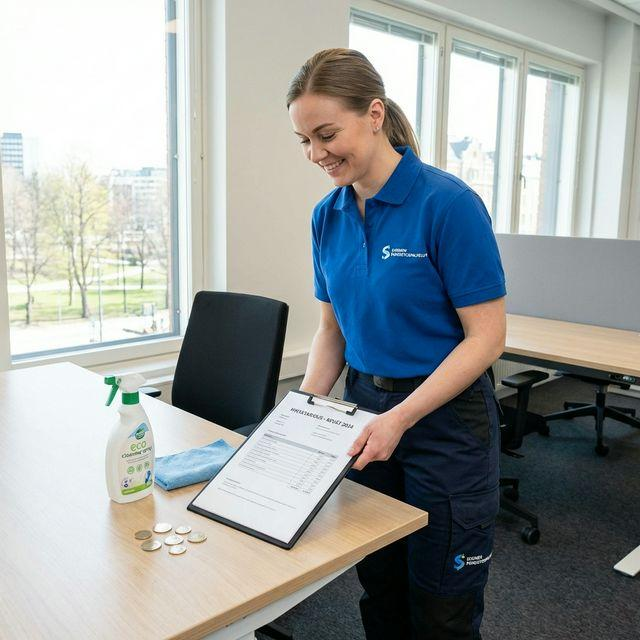
A simple 0–5 scale makes inspections easier to repeat and compare. Define each score before the first inspection so that different inspectors apply the same criteria.
| Score | Suggested interpretation |
| 5 | Fully meets the agreed standard |
| 4 | Minor presentation issue; standard substantially met |
| 3 | Noticeable deficiency requiring correction |
| 2 | Significant deficiency; prompt corrective action required |
| 1 | Major failure against the agreed requirement |
| 0 | Task not completed or area seriously non-compliant |
| N/A | Not applicable or outside the agreed scope |
The inspector should record the observation supporting each rating. A score should never be based solely on whether an area looks acceptable at a glance.
Calculate the weighted inspection score
Where some areas are more important than others, assign agreed weights to the inspection categories.
Weighted score (%) = Total weighted points achieved ÷ Total applicable weighted points available × 100.
For example, suppose a hypothetical inspection produces 86 weighted points out of a possible 100. The overall score is 86%.
An illustrative reporting framework might classify 90–100% as satisfactory, 80–89% as requiring improvement, and below 80% as requiring a formal corrective-action review. These are example bands, not an industry-mandated scale. Set suitable thresholds in the contract and consider the nature and severity of individual defects.
A critical hygiene or safety failure must be escalated regardless of the overall score. A clean reception area should not compensate for an unresolved serious problem in a washroom or another high-risk area.
Office Cleaning Inspection Checklist by Area
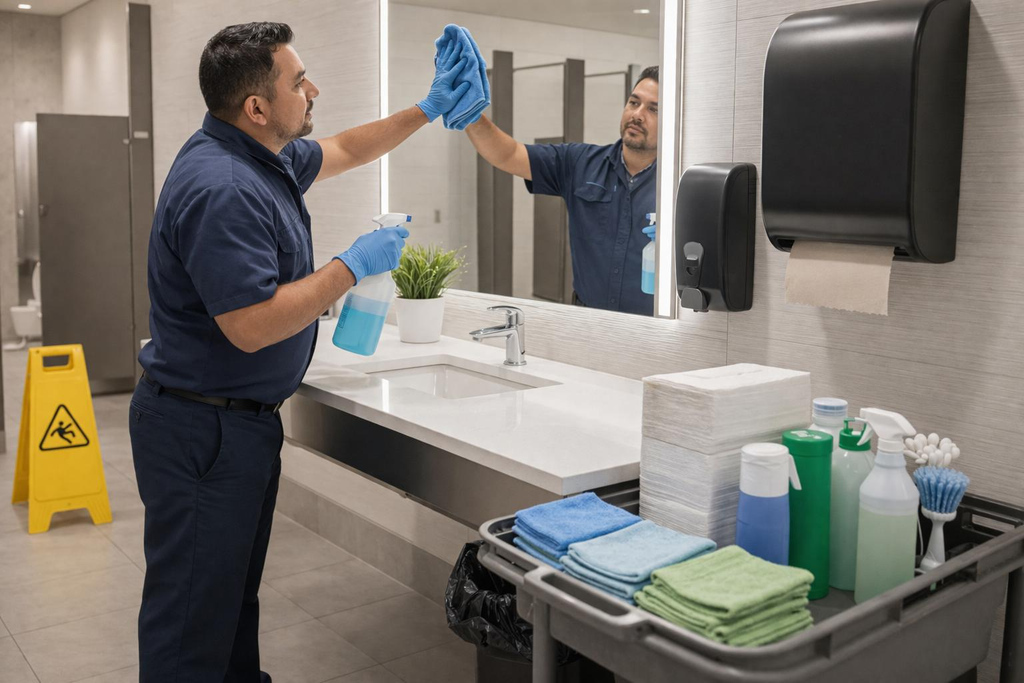
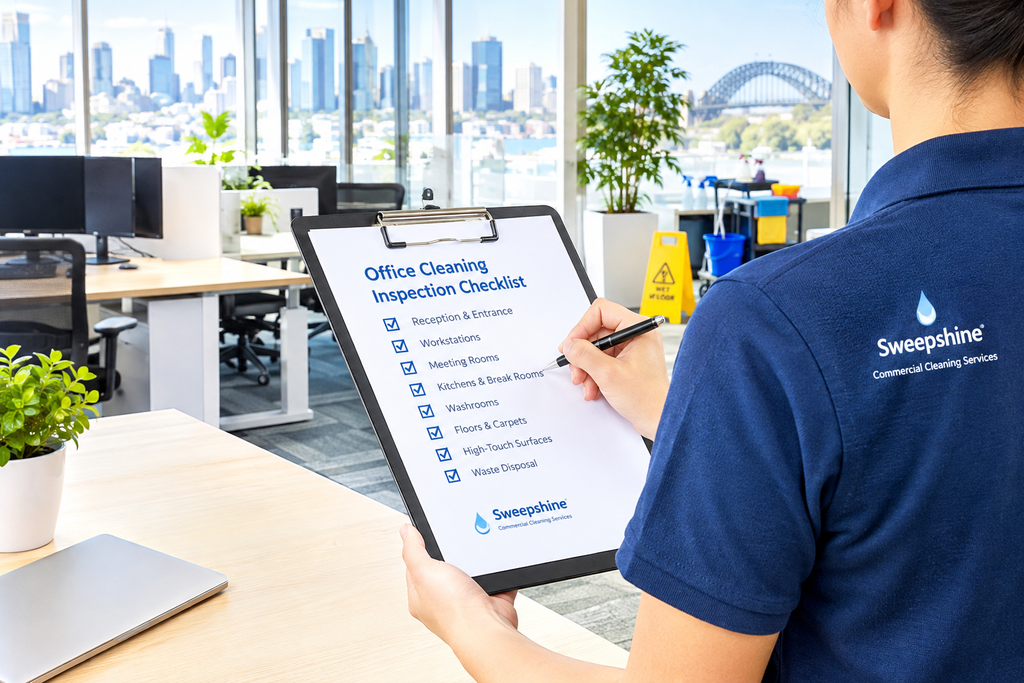
Use the following office cleaning checklist as a starting point. Tailor it to the actual scope, site conditions, access arrangements, and agreed cleaning frequencies.
- Reception and entrances: Check visible dust, floor debris, fingerprints on accessible glass, and the condition of bins.
- Workstations and offices: Check agreed desk and surface cleaning, accessible dust, waste removal, and carpet or hard-floor condition.
- Meeting rooms: Inspect tables, touchpoints, bins, floors and glass partitions where included in the scope.
- Kitchens and break rooms: Check benches, sinks, taps, appliance exteriors, waste areas and visible food residue.
- Washrooms: Inspect toilets, basins, mirrors, partitions, floors, odours and required consumables.
- Floors and circulation areas: Check for visible debris, spills, missed edges and residues that could create a slip hazard.
- High-touch surfaces: Verify that the agreed cleaning or disinfection procedure has been completed on relevant handles, switches and shared touchpoints.
- Waste and storage areas: Check bin emptying, replacement liners where specified, waste separation requirements and the condition of accessible surfaces.
For every inspection item, record the result, evidence, defect severity and required action. Use N/A only when the item genuinely does not apply. If an area cannot be accessed, record the reason rather than automatically passing it.
How Often Should Cleaning Quality Be Inspected?
Inspection frequency should reflect risk, occupancy, complaint history, service frequency, and the consequences of a missed task. There is no single inspection schedule suitable for every Sydney workplace.
A practical starting framework is:
- Each service visit: Review task completion and record any immediate issues identified during cleaning.
- Weekly: Conduct targeted checks of recurring problem areas or higher-use facilities where appropriate.
- Monthly: Complete a documented sample-based quality inspection and review outstanding corrective actions.
- Quarterly: Review KPI trends, complaint patterns, scope changes, and whether the cleaning schedule still meets operational needs.
- At contract renewal: Compare documented performance, service requirements, pricing, and unresolved issues before deciding whether the scope needs to change.
These intervals are suggested operating practices, not mandatory industry frequencies. So, make sure you adjust them to the contract and site’s risk assessment.
What Should a Commercial Cleaning Scope of Work Include?
A commercial cleaning scope of work should specify what is cleaned, where, how often, and to what observable standard. It should also explain how performance is inspected and what happens when the agreed result is not achieved.
Include:
- Areas, surfaces and tasks covered by the contract.
- Daily, weekly, monthly and periodic cleaning frequencies.
- Agreed outcomes and inspection criteria.
- Access arrangements, security requirements and after-hours office cleaning procedures.
- Responsibilities for consumables, equipment and waste.
- Exclusions, additional services and variation approval.
- Inspection frequency, KPI calculations and reporting responsibilities.
- Defect severity, corrective-action deadlines and escalation contacts.
- Incident reporting, site safety and applicable contractor-screening requirements.
This level of detail helps the client and cleaning provider establish consistent expectations. It also makes it easier to compare tenders fairly and identify whether a lower quote reflects a genuinely more efficient service or a narrower scope.
Special Considerations for Sydney Schools and Colleges
Educational facilities require cleaning arrangements that reflect student safety, site access, operating hours and the needs of different spaces. Classrooms, amenities, staff rooms, shared equipment and high-traffic areas may require different inspection priorities.
For NSW public school sites, the Department of Education announced that valid paid Working With Children Check clearances would be required for all contractors from 1 September 2026. Confirm the current requirements and any site-specific screening or induction obligations before a contractor starts work.
A school cleaning scorecard should also consider:
- Completion of required site inductions and access procedures.
- Safe chemical storage, handling and use in accordance with applicable requirements.
- Cleaning schedules that minimise disruption to students, staff and campus operations.
- Appropriate reporting of hazards, damage, incidents and child-safety concerns.
- Documented completion of agreed cleaning tasks in classrooms, washrooms and communal spaces.
- Escalation procedures for urgent hygiene concerns or inaccessible areas.
How to Use the Scorecard When Reviewing Office Cleaning Services in Sydney
A scorecard is most useful when it informs a decision rather than simply producing a percentage.
When reviewing an existing office cleaning provider in Sydney, compare recent inspection results, recurring defects, complaint records, corrective-action closure, and any changes to site usage. Discuss the underlying cause of repeated failures before deciding whether the scope, schedule, or supervision needs adjustment.
Also, when comparing commercial cleaners in Sydney, request the proposed cleaning scope, task frequencies, inspection process, reporting format, insurance evidence, and applicable compliance documentation. Compare like with like: a quote that excludes periodic tasks or consumables is not directly comparable with a more comprehensive service.
Before renewing a contract, agree on the reporting period, score thresholds, escalation process, and responsibilities for resolving defects. Make sure you document material changes to the scope rather than relying on informal instructions.
Frequently Asked Questions
A score of 90% or above can be used as an illustrative satisfactory target, provided it is agreed in advance and suits the site’s risk profile. Any critical hygiene or safety failure should trigger the appropriate escalation regardless of the average score.
Consider inspection pass rate, task completion, repeat-defect rate, corrective-action closure, substantiated complaints, and consumable availability. Define each calculation, reporting frequency, evidence source, and agreed target in the contract.
A monthly documented inspection is a practical starting point for many offices, with more frequent checks for high-risk areas or recurring issues. The contract and site risk assessment should determine the final frequency.
Include the agreed cleaning standard for each area, an inspection score, evidence of any defect, severity, corrective-action owner, due date, and closure status. Cover washrooms, kitchens, workstations, floors, waste, and relevant high-touch surfaces.
Use the same written criteria, scoring rules, and inspection method over time. Combine observed cleaning outcomes with task records, complaint trends and verified corrective actions instead of relying on general impressions.
Requirements depend on the school and contract. Confirm the cleaning scope, insurance, site inductions, relevant Working With Children Check clearances, safe chemical procedures and documented quality reporting before services commence.
No. A high average can conceal an important defect. Inspectors should record and escalate critical hygiene or safety issues separately and assess whether the required cleaning procedures were completed.
Compare the current scope with actual site needs, examine inspection and complaint trends, check unresolved defects, confirm documentation, and compare equivalent service proposals. Use the findings to revise the scope, reporting requirements, and performance targets.
Review Your Office Cleaning Requirements with Sweepshine
If you are reviewing a current cleaning arrangement or preparing a new contract, a clear scope of work and a consistent inspection process can make performance easier to assess.
Sweepshine provides tailored office and commercial cleaning services in Sydney, with service arrangements designed around the requirements and operating hours of each workplace.
Visit the Sweepshine office cleaning page or contact the team to discuss your site’s cleaning requirements and request a no-obligation assessment. You can use your existing checklist or inspection scorecard as a starting point for the conversation.